Friday, December 29, 2017

Failure

Failed to produce my blog on schedule last Monday, can't think why.

Failed to promote Wilful Misunderstandings in the run-up to the festive season, thus depriving myself of a potential sales cascade.  So all I can do is appeal to anyone with £6.95 (plus p&p) left to spend after the annual hoopla, with the following ad.  (And if you can afford it, buy it from Lepus not Amazon or similar please - cheap as they sell it, I get mere pennies, and I've yet to cover the costs of the printed copies I sell through Lepus...)

No other failures to report.

Wishing all readers of this blog a happy new year.

RF

Monday, December 11, 2017

We Are Crazy (and not in a good way)


An article in New Scientist magazine (25 Nov, issue 3153, p 12) brought home the impact of something I’ve a tendency to regard in a sort of intellectual way that, normally, does not have an impact on my personal sense of wellbeing.  It is that, as a species, human beings – all of us – are well and truly mad.

Under a headline ‘Using bombs to bomb-proof cars’, NS reporter Paul Marks tells us about the work of Roger Sloman, managing director of a company known as ‘Advanced Blast and Ballistic Systems’.  Sloman and his team are developing a system intended as a countermeasure to protect the occupants of military vehicles under which improvised explosive devices (IEDs) detonate.  Such a blast can, I read, ‘instantly catapult a vehicle many metres into the air’.  Because the floors of such vehicles are strengthened, there is less danger from the blast itself than from the intense upward acceleration, which can seriously or fatally damage internal organs.

Research revealed a ten-millisecond gap between the blast and the lifting of the vehicle.  The idea is that, in this interval, a detector could trigger roof rockets to provide a downward force to keep the vehicle on the ground.  The resulting devices are known as ‘linear rocket motors’ and one of Sloman’s colleagues says: “The peak thrust from all those rocket nozzles is insane.”  (Yes.  Insane.)  In a test one of the vehicles was reckoned to momentarily ‘weigh’ around 120 tonnes.

That life is sacred and that such a device may save lives if it goes into production, I cannot deny.  That such technology may have other uses in different contexts is also mentioned in the article.  What it does not mention is the cost of research, development and manufacture – which I can only assume must be vast.  Our resources on this planet are wearing thin, the fate of the human species is – as far as I can see – in the balance.  Why are we blowing thousands, perhaps millions, (plus brain power and materials that could be better used solving humanity’s mutual problems) on peak thrust rocket nozzles?

It highlights for me a number of underlying assumptions.  There will always be a need for military vehicles.  There will always be people who wish to blast them with improvised explosive devices.  There will always be conflict between human beings.  Investment in military hardware provides jobs and economic growth and this somehow benefits all of us.  I could go on but I’m sure you get the picture.  All these statements are interlinked.  It’s a house of cards that stays intact because it is part of the consensus we call reality.  Is it possible that simply by not accepting these and similar assumptions we could change the picture?

But this article had the effect of renewing and refreshing my sense of shock at what we humans routinely do to one another.  Palestine.  Syria.  Yemen.  Afghanistan.  Iraq.  The playing fields for war games.  News of conflict has a numbing effect by its very persistence.  It takes a bizarre story about a hi-tech design to anchor against explosive force (and the sense of black absurdity that surrounds it) to brush away the cobwebs of complacency once more.


(from ABBS website)

Monday, November 27, 2017

Fake News Faked

Cost of living set to hot samba rhythm

According to a new report by the Office for National Statistics, a marked rise in the retail price index has caused the cost of living to soar unexpectedly.  It is currently cruising at an altitude of ten kilometres where Standard atmospheric conditions are −50°C and 26.5 kPa, exceeding the speed of delight.  Up there the samba winds blow hot and spicy, although legislation is called for regarding the illicit use of high altitude drones. 

The cost of living is now a Brazilian musical genre and dance style, with its roots in African religious traditions, particularly of Angola and the Congo.  A spokesperson today spoke of spokes, spoken, smoked and "wholeheartedly" apologised for "any inappropriate behaviour that made some former colleagues feel uncomfortable".  He later added that talks at the end of the two-day summit remained incongruous, and that a former leader, at the leading edge, lead the leaders to swing the lead.

The government is considering the modern samba that emerged at the beginning of the 20th century.  It is predominantly in 2/4 time to a batucada rhythm, with various stanzas measured in terms of purchasing power parity rates.  In keeping with leading edge thinking, the term ‘cost of living’ itself shall from hereon in be known as the ‘costa livin’. 


College award is toast

One of the UK’s biggest bakers has warned that attempting to redress the bitter legacy of slavery is “unsustainable”.  Oxford’s All Souls College is partly governed by overseas prices.  Bread unwittingly contributed to the college’s success.  Today , 42% of Britons commemorate the suffering of low-carb diets, from protein pots and salads to sushi.  Associated British Foods is said to be considering further action to limit carb intake and protest against the commemoration of Cecil Rhodes.  New graduate scholarships will reduce the space devoted to bakery items within the next 18 months.

The change is being led by young people, with only a quarter of 16- to 24-year olds eating “distinguished fellows” including former Conservative cabinet ministers John Redwood and William Waldegrave.  A spokesperson for the college said: “All Souls is pleased to be equating to a loss of about 23m kilograms.  The volume of bread rolls and freshly baked bread sold expresses our present –day values.”

Warburton’s, the UK’s other leading baker, attracted student protests.  A student in chains stood outside the research firm Mintel.  “Bread is on the firing line,” said a food and drinks analyst at Mintel, “we don’t think the steps All-Souls has taken are enough.”  Avocado toast may be an Instagram sensation but has appeared in the Paradise Papers, investing funds offshore in bakeries, making them one of the lowest-cost operations in the country. 


Tuesday, November 14, 2017

Mirror Lore

I had a close shave the other day.  After the soap suds were scraped away, there was my face, craggier and more laden with jowl than I’d really be happy to see.  I looked deep into my eyes and, curiously enough, my eyes looked back into me.  I wondered what I was really looking at, what was looking at me.  Light cast back from whence it came by a cunningly engineered combination of glass and silvery metal?  Or was there something about this experience that went deeper?  It seemed I had some research to do.

I started with some vampire lore.  These pasty-faced, bloodsucker types, it states, have no mirror image.  It would appear that Bram Stoker may have been the originator of this idea.  It is based in part on the concept that the mirror gives a reflection not just of one’s appearance but also of the soul, thus vampires being soulless have no reflection.  A pseudo scientific explanation by modern fantasists has it that it is down to the silver backing in old mirrors – silver having properties to ward off evil – and thus since modern mirrors do not use silver, vampires can scrub their fangs and brush their hair, safely reflected, like the rest of us.

The mirror as portal is an established motif – whether it goes any further back than Carroll’s ‘Through the Looking Glass’, I don’t know.  As an image it is used to great effect in Jean Cocteau’s film ‘Orphee’, in which Death is personified as an elegant, fashionably dressed French woman.  She and her assistants emerge from and return to the Underworld through mirrors.  Scenes in which this occurs were shot horizontally, using framed pools of liquid.  For all the crudity of this technique, in comparison to what can be done today with computer graphic imagery, there is something about its conceptual simplicity that creates a sense of extraordinary beauty and other-worldliness.  For this and its many other beauties, I never tire of watching this film.

Before I leave ‘Orphee’, here is a quote from its script: ‘Mirrors are the doors through which Death comes and goes. Look at yourself in a mirror all your life...and you'll see death at work like bees in a hive of glass.’  The first sentence deals with what I have described, in the second mirrors are considered as monitors of an inevitable process, a slow revelation of what we are, not only in the spatial dimensions but also in the dimension of time.  Or something like that, anyway.

The mirror or the reflective surface crops up frequently in myth, legend and literature.  A quick trawl takes us through Narcissus, whiling time by staring at his reflection in a pool; Snow White and the mirror on the wall; the Lady of Shallott viewing Camelot through a magic glass and many a scary story in which something is seen in the mirror which is not apparent elsewhere.  Then, of course, we have the common belief that breaking a mirror brings a seven year period of ill-fortune.  Seven years?  Again we are looking at the mirror as a reflection of the soul, its breakage the breakage of the soul, and the seven year period being the time it takes – it is said - for the soul to regenerate.  It is therefore somewhat lacking in apparent logic that various antidotes to this problem are listed involving grinding the shards of mirror to dust or burying them.  With regard to the soul, I suspect that the devisers of these remedies have not entirely thought it through.  But who am I to question superstition?  You breaks your mirror and you takes your choice.

There are also traditions in various cultures that, when someone dies, all the mirrors in their household should be covered.  Mirrors (perhaps in their role as Cocteau’s portals to the Underworld) can, they say, act as lures and traps for the souls of the newly departed.  A handy bit of blanket coverage for a prescribed period of time enables a safe passage to…  well…  wherever it is that the deceased persons are supposed to be going.

My search for that which is associated with mirrors has been fruitful.  A further trawl of mythology across the world would no doubt generate more.  So what’s it all about?  Thomas Hardy, in a well known poem, peers into his looking glass and views his wasting skin, but his subsequent reflections (pardon the pun) are to do with ageing itself, rather than the act of observation that triggers them.  He’s not looking at this wealth of lore we invest in the silvered glass.  But it’s there, layered into our mindsets, even if we are not familiar with every last myth, tale or superstition.

Perhaps the potency of the mirror as an image lies in the mystery of human consciousness.  We are our own mirrors, looking at ourselves constantly as we parade through our waking lives.  Perhaps the pun is no coincidence – the throwing back of light and the going back in thought are intertwined concepts.  Hardy can’t look into his mirror without looking into himself.

And it is one of the scientific tests used to determine levels of conscious awareness in other species.  Dolphins and other beasts whose intelligence is in evidence are said to be able to recognise themselves and others in a mirror.  Frogs, it is generally accepted, cannot do this.  A certain level of consciousness is required to both to reflect and to be aware of a reflection.

The mirror, I conclude, is a potent thing.  It tells us more than meets the eye.


Monday, October 30, 2017

'Abandon the Platform for the Round' RG Gregory 1928-2017

A couple of blogs ago I wrote a little about my time in Word and Action (Dorset) back in the early 1980s and gave a few links to the Wikipedia page for W&A and to sites connected with its founder and leading light, the poet and playwright RG Gregory.  About a week ago I heard that he had died.

I’d known he’d been ill and had visited him last year with good friend and ‘Slugger O’Toole’ blogger Michael Fealty.  At that time, there was a faint hope that he had been mis-diagnosed, but by the time I heard he’d died I knew this was not the case.  Nevertheless I find I am deeply affected by the news.  I’m not alone in this – on his Facebook page there are many tributes from family, associates, ex-W&A members and others.  (https://www.facebook.com/rg.gregory.5)

‘Greg’ as he was known was a powerful influence on the lives and thinking of many people.  I’m not going to attempt a biography or a full list of his achievements here.  You can find out more at the sites I gave in the ‘Girl from the North Country’ review blog, or at this – a more recent site that I didn’t remember to add - http://www.rggregory.co.uk/ .  What I’d like to add is a few words about some of the ways he affected my thinking and outlook.

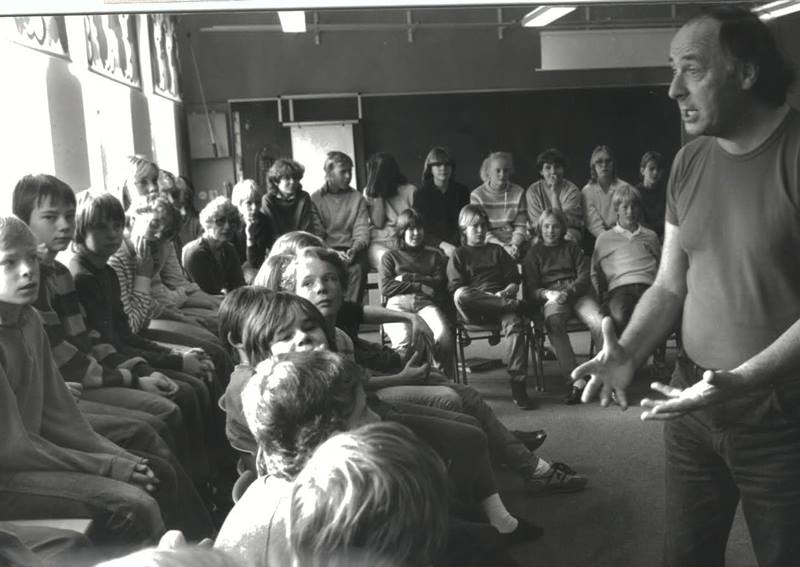
One of the main activities of the W&A group was the performance of what became known as ‘Instant Theatre’.  It was the embodiment of many of Greg’s ideas.  It developed out of experimentation with theatrical forms and participatory theatre that took place, as I understand it, in the 1950s and early 60s.  Greg at that time became attracted to working ‘in the round’ which, in his opinion, removed the underlying hierarchy implicit in staged performances.  It drew ‘actors’ and ‘audience’ into a closer and more responsive relationship.  The shedding of theatrical effects - costumes, scenery, special lighting, sound effects etc – enabled a greater exercise of the imagination and creativity in all participants.

‘Instant Theatre’ took place in the round, and was a genuine and effective attempt to give an ‘audience’ the opportunity to make up a story on the spot, to have it dramatised, and to participate in the performance.  Greg felt that many attempts by others to do this fell short because the ‘professionals’ would tend to lead the ‘audience’ towards what they were prepared to do, not what the ‘audience’ was capable of creating given free rein.

It was generally performed by teams of three people.  The ‘Questioner’ would introduce the process and elicit the story by means of a question and answer process.  As far as was humanly possible, the questioner had the responsibility to make the questions completely open, not to lead the story in any way.  S/he was not to assume anything on behalf of those who gave the answers.  The questioner would, however, use his/her own judgement as to how much information constituted a scene of the story to be acted out and at that point re-tell what had been gathered so far (inviting its providers to correct any mistakes).  Then the ‘audience’ would be invited to join the other two team members in acting out their story.  Not only would people (adults and/or children) play the characters, they would also ‘be’ the props.  This would continue, scene by scene, over the course of an hour.  (In that respect there had to be an element of leading – a reminder that the time and therefore the story would have to come to an end.)  Instant Theatre was often huge fun.  Sometimes it was chaotic.  Often it hit extraordinary levels of profundity.

To work well the questioning had to be a quick-fire process.  Instant Theatre was not created out of discussion as to what would make the ‘best’ story.  Considered thought was cut to a minimum.  In this manner, if it was working well, the stories tapped what Greg (and many others) believed to be the ‘collective unconscious’.  They would work on an archetypal level.  They would take unexpected forms. 

Except when working with younger children, the questioner would ask for answers to be called out, so would have to include anything s/he genuinely heard.  This led to the incorporation of contradictory answers.  The question always followed – both these answers are right because I’ve heard them, how can they both be true?  It invited lateral thinking. 

All this was an eye (and ear and mind) opener for me.  In Greg’s thinking, the principles applied to more than theatre, they applied to the way we live our lives, the ways in which we organise our society and make our decisions and more.  Think it through.  The extent to which so many of us live vicariously through our ‘celebrity’ culture, admire ‘personalities’ in general, imagine that ‘charisma’ is a necessary quality in those who seek to lead - all this has its roots in the idea that those people up on the stage are somehow better than us.  Are they?  Why do we cling to oppositional politics when you could say: how can both answers be true?  And if we did, could we find ways to work together for the greater good?  Could our politics come up genuinely from people rather than down from politicians manipulating people for their (and their lobbyists’) own ends?

It was, within my own relatively simplistic thinking, questions like these I found myself asking as Greg’s ideas filtered through to me.  You can go a lot deeper with them than I have here.  Greg’s own writings are lamentably erratically published, but check out the websites I’ve given if you do want to know more.  Also a series of conversations recorded on YouTube with Michael Fealty, starting with https://www.youtube.com/watch?v=sosY7kMYIag

It’s a personal and minority opinion, but with Greg’s death I think we’ve lost one of the great thinkers of our time.  His work and its value go largely unrecognised, probably because too many influential people have too much by way of vested interest in the status quo he challenged.  To acknowledge such a maverick thinker would be tantamount to undermining their own power bases.  The apple cart remains upright.


(I’ve written about this in the past tense, but gather there are practitioners of Instant Theatre still operating.  How true they are to Greg’s principles, I don’t know.  I’d be happy to hear more about them.)


Monday, October 16, 2017

Me and Paul Simon Down in the MRI Scanner

A week ago last Sunday saw me, thanks to our 24/7 National Health Service, spending an hour inside an MRI scanner at a local hospital.  Fans of Industrial Noise music, be advised.  Never mind your Merzbow, your Matmos or your Pan Sonic, MRI scans are the business.  For a start, you are lying in a white plastic tube, with a few dirty grey smears just above your face.  All the alienation you could want.  For each of the several short scans, you get a different noise.  The most prevalent one resembles a road drill, others involve various hideous bleeps and thumps and sort of 1940s/50s alarm siren noises.  Noiseniks, welcome to heaven.

You would of course turn down the offer of protective headphones from a kindly nurse.  You’d want every last decibel, full on.  You’d probably want to sample it and loop it onto a CDR or whatever, but given the powerful magnetic fields being generated, that might not work out too well.

But I’m a wimp, I’m afraid.  I took the earphones.  I was asked what sort of music I’d like to be played through them.  Pop, Rock or Classical?  60s, 70s or 80s?  Dreading the thought of being trapped in the machine for an hour with Englebert, Mungo Jerry or Yazz, I thought as fast as I could and asked:  “Have you got anything sort of quiet and folky?”  At that point in the proceedings, obviously, little did I know how useless an option that would be.

“We have some Simon and Garfunkel,” came the reply.  Not wishing to prolong the proceedings unnecessarily by asking for a run-down of the entire catalogue of available music, I agreed to Paul and Artie.  I mean, they were hardly likely to offer me any John Renbourn, were they?  And besides, I once loved the music of Simon and Garfunkel quite deeply.  Their ‘Parsley, Sage, Rosemary and Thyme’ album was amongst the first twenty LPs I ever owned.  Okay, some of it sounds a bit twee to my ears now, but ‘The Dangling Conversation’ still sends a strange shiver down my spine.  ‘You read your Emily Dickinson / and I my Robert Frost / and we mark our place with bookmarkers / and measure what we’ve lost.’  Haunting.  And although the slang has long since been dragged through the mud, ‘The 59th Street Bridge Song (Feelin’ Groovy)’ still cheers my heart.

But with the next album, ‘Bookends’, Paul Simon really upped his game.  I can’t remember the exact chronology but this was the time of Sergeant Pepper and those kind of mini-epic singles like the Stones’ ‘We Love You’, the Yardbirds ‘Happenings Ten Years Time Ago’ or Pink Floyd’s ‘See Emily Play’.  Simon came up with a sequence of singles that were more than a match in terms of both intricate construction and lyrical sophistication: ‘Hazy Shade of Winter’, ‘At the Zoo’, ‘Fakin’ It’ and ‘Mrs Robinson’.  And they were all on one side of ‘Bookends’ whilst the other side featured a suite of superb new songs I can still listen to with absolute enjoyment to this day.

I recently saw a U-Tube clip of David Bowie respectfully performing one of those songs, ‘America’.  He just sat cross legged on the stage playing a small keyboard, with no other accompaniment.  I’ve not been much of a Bowie fan since ‘Hunky Dory’ but I had to admit, in that simple rendition of its wistful, romantic, stirring lyric, he nailed it big time.  Once again: haunting.

So I’m being rolled into the scanner on the stretcher thing, these huge earphones covering my ears, hands on my chest, my belly covered with some sort of plastic rig that will facilitate the scanning process, along with another plate thing under my bum, and I’m thinking ‘What’ll it be?  Which album?’.  I figured the most likely thing would be a best-of compilation.

And there I am, staring up at the grey smears in my tubular tomb-like enclosure and the music starts.  What is it?  It’s ‘Bridge Over Troubled’ bloody ‘Waters’, that’s what it is.

‘Bridge Over Troubled Waters’ was probably my first experience of discovering that even my favourites could well turn out to have feet of clay.  It was presaged by ‘The Boxer’ – a worthy finale to that succession of psychedelia influenced singles mentioned above, but this turned out to be Simon’s last gasp for a long, long time.  Well, for me at least.  The rest of the album was a huge disappointment, pleasantly bland at best, occasionally descending into downright irritating.  There’s probably a story about it somewhere, but I suspect a succumbing on Simon’s part to be more ‘commercial’.

At which he was entirely successful, because if I remember rightly ‘Bridge’ was S&G’s highest selling album.  Which, I guess, is why it was the one I then had to endure.  Fortunately, once the noise started, the earphones proved to have little effect, except perhaps to protect me from the eardrum battering intensity of the MRI machinery.  I’d get to hear a bar or two of ‘Cecilia’ or ‘El Condor Pasa’ from time to time, before the nurse’s voice cut in to tell me the next scan would last for four minutes and the rat-attat-tat, clanging, honging and tweeting would start up again.  All I could hear of S&G in these interludes was the bass-lines, a bit of percussion and occasionally the vaguest hints of the melody.  I retained some hopes I might hear at least some of ‘The Boxer’ but that too was utterly drowned.

Credit is of course due to the NHS.  I am blessed to have such a service to check whether I may or may not be suffering from a medical condition.  I loathe the creeping privatisation that is gradually undermining its structure and effectiveness.  I am profoundly grateful to all the hard working men and women who keep it operating, especially those who more or less saved my life a few years ago.  I am grateful too that they think to provide earphones and music for people going into MRI scanners.  I’m sure 99.5% of us appreciate it. 


As for the other 0.05%, this has to be your big chance.  Go for it, noiseniks!


Monday, October 2, 2017

Girl From the North Country converts a doubtful theatre goer

Though finding most forms of artistic endeavour attractive and often immersive, I’ve never been strongly attracted to theatrical works.  I can acknowledge that many of them are great and have been an audience member for a few of them, but it’s not an art-form I have ‘followed’ or even paid a great deal of attention to.  Consequently I’ve not had any great desire to write for the theatre.

And certainly not to act.  I enjoy performing, as anyone who has heard me reading from ‘Wilful Misunderstandings’ will probably confirm, but anything that would depend on learning ‘lines’ is pretty much out of the question as I have a distinctly malfunctioning memory.

It may be somewhat surprising, therefore, to hear that I spent some years in the early 1980s as a member of a touring theatre group.  There is an explanation.  The group, Word and Action (Dorset), was to a large extent run on a collective basis and had branched out into various ‘community arts’ activities including publishing.  I joined because they were looking for someone to co-ordinate a poetry magazine.  A different Dorset based poet was invited to edit each issue – I was to be the ‘go-between’.  Fine.  I was cut out for that.  But then they said: ‘this is a collective.  You participate in everything we do.’  Gulp.

But what they did, I certainly admired.  It was, on absolute principal, 'theatre in the round' – no special lighting, no special effects or soundtrack, virtually no scenery or costume.  It was a form of theatre that sought to remove any sense of hierarchy that exists between performer and audience, and to enable audience members to use their own imaginations to a much greater degree.  (I’ll add a couple of links at the end for anyone interested).  Much of W&A(D)’s work was improvised, audiences being invited to create - and join in performing - the story.  To my surprise, with some in-group training, I discovered I had whatever it takes to be a part of this process and ended up working not only in Dorset but joining touring groups in the UK and Scandinavia.  When it came to the scripted work I remained crap and fortunately was not called upon to do much of it.

I left the group after two or three years, following my own star once more.  Its view of theatre had made a lasting impression on me and I was deeply suspicious of any kind of staged theatrical performance.  This combined with my earlier lack of interest, and though in time I mellowed, theatre remained low on my list of priorities.  Consequently, when I left a subsequent employment in 2012 and my generous work colleagues presented me with a substantial pile of theatre tokens as a parting gift, I was bemused.  I made polite noises of gratitude and privately thought: ‘What am I going to do with these?’

Five years later and I finally got to use some of them.  Passing through London on the train I saw a poster advertising ‘Girl From the North Country’ and was intrigued.  Written and directed by Conor McPherson, it said, music and lyrics by Bob Dylan.  McPherson was a ‘complete unknown’ as far as I was concerned.  Dylan certainly wasn’t.  Checked it out online back home and the intrigue continued.  Discovered I could use my tokens at the Old Vic where it was on.  Asked my dear partner if she was up for it and she was.  Thus, last Wednesday, we found ourselves sat in the middle of Row R, in stall seats we would normally have balked at paying for, as the performance commenced.

As I hope I’ve explained, I had a lot of suspicion to overcome – and I haven’t even mentioned yet that of all forms of theatre ‘musicals’ were at the bottom of my list.  I’m not among the most fanatical of Bob Dylan appreciators, but can think of few other songwriters whose best work has remained so resonant and powerful for most of my life.  The play uses songs from 1963 to 2012, and plenty of my favourites are amongst them.  What were they going to do?  Give them the ‘showbiz’ treatment?  The thought appalled me.

Some reassurance came with the instrumentation evident on the stage – a drumkit to stage right, an upright piano to stage left.  Not much else to be seen until musicians appeared toting acoustic guitars, upright bass and fiddle.  The choice was, apparently, to use only instruments contemporaneous with the play's 1930s period setting.  Further reassurance came with the first song: ‘Sign on the Window’ from ‘New Morning’.  Beautifully sung, the freshness and suggestiveness of the lyrics (‘Sign on the window says "lonely, " / Sign on the door said "no company allowed, "…’) seemed re-illuminated for me.

It aptly, if not literally, set the atmosphere for the play that was to follow – an interweaving of stories set in the single location of a Duluth, Minnesota guesthouse during the Depression era.  The various characters are beset by tragedy, some of their own making, some forced by desperate circumstance – yet the script is loaded with humour and sharp repartee.  It doesn’t take long before you feel for them, share their hopes and aspirations and, as the chips go down, their despair.

As for the musical interludes – which is how they came, often as medleys of two or more songs – the pattern of aptness, rather than literal correlation became set and worked, for me, extremely well.  This approach has been described by the play’s creators as ‘a conversation between the songs and the story’ and, thinking about it, is probably the only way you could locate some of Dylan’s most powerful songs in such a context.  It helped that the performers, almost every last one of them, were such strong and impassioned singers and that the musical arrangements were mostly spot-on appropriate.

A few liberties were of necessity taken.  Lyrics to the songs were edited (how long would it have taken just to listen to those twenty songs in their entirety?) and were arranged and interpreted according to the emotional context of the scenes in which they featured.  Very occasionally, I did get a ‘showbiz’ vibe – the performance of ‘I Want You’ kind of palled for me, losing too much of the laconic splendour of its verses in favour of an over simplified emphasis on its chorus.  But this was a minor slip.  A lot of attention had been paid to the vitality of Dylan’s ‘born again’ era gospel-type arrangements and even when they did not originate in this period, a lot of the songs benefited from the additional harmonies etc.  The dancing was pretty darn good too.


So, as you’ve doubtless guessed by now, I was won over in the course of this performance.  It was particularly enhanced by what seemed to me a stand-out job of work by the diminutive but powerful Shirley Henderson, as Elizabeth, wife of the guesthouse proprietor, Nick.  Described as a victim of dementia her character provided a kind of ‘holy fool’ element – apparently deranged yet speaking, at times, the most penetrating truths.  This actress clearly relished the part and sometimes literally threw herself into it, managing to maintain her sense of her character even in the group dance routines.  Her rendition of ‘Like a Rolling Stone’ touched on the sublime.  I’ve singled her out but similar relish could be felt in a good many more of the character parts, and – towards the end – the script touched on deeper and more fundamental human issues.  I will be keeping an eye open for more of Conor McPherson’s work in future.

Okay, now I have to admit, I was in tears at the end.  There was tragedy, there was redemption for some, and there was a final rendition of ‘Forever Young’ – one of Dylan’s sweetest and most hopeful songs.  As much as the story and the performances, it was the sense of celebration of Dylan’s work that affected me so strongly, I think.  So final words to him:

Can you tell me where we're headin'?
Lincoln County Road or Armageddon?
Seems like I been down this way before
Is there any truth in that, seƱor?


Word and Action links:
https://en.wikipedia.org/wiki/Word_and_Action
http://www.rggregory.com/
http://roundtheatre.blogspot.co.uk/