Monday, April 25, 2016

Retakes of a Formal Nautilus - Oulipo Enlarged, part 2

More on the Oulipo, as promised.  A closer look at the concept of 'constraints' and their potential benefits to the writer and a look at one or two key works.  As before I've used 'N+7' to derive my title from a phrase in the first paragraph that follows it.

Last time we reached the point where we discover the derivation of the term 'Oulipo' from the official title of the movement: ‘Ouvroir de Littērature Potentielle’ 


Retakes of a Formal Nautilus - the Oulipo Enlarged, part 2

‘Potential literature’?  In essence the group is concerned “not with literary works but with the procedures and structures capable of producing them.”  Oulipo’s aim is “to invent (or reinvent) restrictions of a formal nature (constraints) and propose them to enthusiasts interested in composing literature.”

“Describable, definable, available to everyone, Oulipian constraints provide the rules of a language game whose ‘innings’ (texts composed according to its rules) are virtually unlimited and represent linguistic combinations developed from a small number of necessarily interdependent elements.”

“The Oulipo’s work is collaborative, and its products – proposed constraints and their illustrations – are attributed to the group, even if certain constraints are invented by individuals.”

“Oulipian writing – that is, writing with constraints – endeavours to rediscover another way in which to practise artistic freedom, one that is at work in all (or nearly all) the literatures and poetic enterprises of the past: the freedom of difficulty mastered.”

“An Oulipian author is a rat who himself builds the maze from which he sets out to escape.”  (All above quotes from Jacques Roubard: ‘The Oulipo and Combinatorial Art’ – 1991.)

Oulipo membership is international, these days, although it remains predominantly French.  But in considering these individuals one should bear in mind another quote from Jacques Roubard: “the members of the Oulipo are characters in an unwritten novel by Raymond Queneau”.

In keeping with its origin as a sub-committee of the College of ‘Pataphysics, the group has an intentionally absurd beaurocratic structure.  Yet it has remained sustainable.  They have met on a monthly basis throughout the 56 years of the Oulipo’s existence, and have attempted meticulously to record the minutes of each meeting.  There are two secretaries: the provisionally definitive secretary and the definitively provisional secretary.  New members may be co-opted by the group, and no one can be expelled, or resign, or stop belonging, whether living or dead.  However, according to the rules:

“One may relinquish membership of the Oulipo under the following circumstances: suicide may be committed in the presence of an officer of the court, who then ascertains that, according to the Oulipian’s explicit last wishes, his suicide was intended to release him from the Oulipo and restore his freedom of manoeuvre for the rest of eternity.”

So, fortunately, there is a way out.


Oulipian Works

Given its commitment to working collaboratively, one could be forgiven for thinking that no Oulipian work of literature should be known by the name of its author.  But hey, if you don’t put your name about…

Two of the most highly regarded works by Oulipian writers illustrate different ‘constraints’.

Georges Perec’s ‘A Void’ (original French title: ‘La Disparition’) is a novel written entirely without using the vowel e.  Its characters’ inability to name the missing letter leads to their deaths, thus adding the constraint as a kind of meta-fictional device in addition to its mechanical function in the text.  It includes extracts from well-known poems and classic novels rewritten to exclude the letter e.  It’s an example of what the Oulipians call a ‘lipogram’ – a text that excludes one or more letters of the alphabet.


Probably not sustainable for the length of a novel are some of the fiendish variants on the lipogram, such as ‘the prisoner’s restriction’ in which we are asked to imagine we are prisoners with extremely restricted supplies of paper.  To maximise its use, we eschew the letters of the alphabet that go above or below the line and confine ourselves to the letters a c e I m n o r s u v w & x, as we can see now in one wee excursion…

Raymond Queneau’s ‘A Hundred Thousand Billion Poems’ was the product of an amazingly challenging constraint.  Queneau set himself the task of writing 10 14-line sonnets, each with an identical rhyme scheme and grammatical construction.  In the original edition of the book, each of them is printed on a page cut into 14 strips, thus making any line of any of the sonnets interchangeable with any of the 10 corresponding lines from any of the other sonnets. Whatever the resultant combination, the grammar and rhyme remain intact.


Queneau calculated that this created 1014  different possible combinations, each readable as an admittedly somewhat bizarre sonnet, the ‘100,000,000,000,000 Poems’ of the title.  Its translation into English was greeted by its author with “admiring stupefaction” and is the work of one Stanley Chapman, a member of the Oulipo since 1961 and attainer of the rank: ‘Regent of  Epideictic Oratories and Displays’ in the College of ‘Pataphysics.  Clearly a man of considerable accomplishment.

The work of Oulipian writers has been published since 1974 in ‘La Bibliothēque Oulipienne’, a numbered series of pamphlets written by one or more Oulipians, and appearing almost invariably in limited editions of 150.  Some of these have been translated into English, published by Atlas Press.  An extremely useful introduction can be found in the same publishing house’s ‘Oulipo Compendium’, edited by Harry Mathews and Alastair Brotchie, and my main source for this piece.


Next time, I have a go at trying out a 'snowball', some 'perverbs' and a 'beautiful in-law', as we continue to explore the world of Oulipian 'constraints'.  'Til then, may the long time sun shine upon you.


Thursday, April 14, 2016

A Moya Based in Frangipane - Oulipo Enlarged, part 1

Hi all

Alan Moore, in his generous and characteristically insightful recommendation for my book 'Wilful Misunderstandings' (the one I'm now trying to sell, remember?), spoke of the 'oulipo toolkit' which he felt I had employed.  Since the book has become available, a number of people have already asked me smart and well-informed questions like: "What's this 'oulipo' then?"  The short answer is that they (the 'Oulipo') are a group of writers mainly but not exclusively based in France, who hold some wonderfully challenging ideas about the art of writing.  Over the next few weeks, I shall attempt to provide some idea of what the Oulipo are about.

Needless to say, there is perfectly good description of the Oulipo and their activities on Wikipedia.  They have their own web pages, and there are some other fine pieces about them that turn up on a Google search.  So this is just my take on them, in which I attempt to take on some of the smaller challenges they present.  These take the form of 'constraints', a concept which will be explained more fully later on.

We start with some introductory comments and then go on to a brief digression regarding their antecedents, the pataphysicians...

A Moya Based in Frangipane - the Oulipo Enlarged, part 1.

This is not the first, nor the most definitive piece of writing to concern itself with ‘Oulipo’, a literary movement based in France, whose foundation took place in 1960.

I will now apply one of the Oulipo’s ‘constraints’, known as ‘N + 7’ amongst other names, to the above paragraph.

This is not the fish, nor the most definitive pietism of xanthophyll to concern itself with ‘Oulipo’, a literary moya based in frangipane, whose foursome took place in 1960.

That’s what they do, the Oulipo, they fuck around with words, but employing care and precision in the process.  ‘N + 7’, for example, is applied by replacing each noun in a text with the seventh noun following it in the dictionary.

Here’s one they did to the beginning of the Book of Genesis:

‘In the behest, God created the heckelphone and the easement.  And the easement was without format, and void: and darshan was upon the facial of the defeasance.  And the spirituousness of God moved upon the facial of the wattles.  And God said, Let there be lights: and there was lights.’

If you, like me, enjoy making language a playground for purposes both serious and trivial, the Oulipo are worth knowing about.  Their story is one of eccentricity, wit and extraordinary persistence.  Its roots go back to the Surrealists and to another extraordinary and enduring institution: The College of ‘Pataphysics.


‘Pataphysics

I have now to digress, in a way that I hope will cast light on the Oulipo, into the subject of ‘pataphysics.  The term was coined and the concept was created by the notable turn of the Twentieth Century French writer and absinthe drinker, Alfred Jarry, who defined it as ‘the science of imaginary solutions which symbolically attributes the properties of objects, described by their virtuality, to their lineaments’.  Make of this what you will, ‘pataphysics has also been described as a philosophy dedicated to studying what lies beyond the realm of metaphysics and as dealing with "the laws which govern exceptions and will explain the universe supplementary to this one".

Are you any the wiser?  I do hope not.

The College of ‘Pataphysics became an institution in 1948, long after Jarry’s untimely death in 1907.  Its early members included Joan Miró, Marcel Duchamp, Eugene Ionesco and the Marx Brothers.  Its UK branch is the London Institute of ‘Pataphysics.  In a 2005 Guardian article, writer Zoë Corbyn described the college as an “elaborate pose”.  She continued: “Nonsensical beaurocracy is its hallmark and with a remit to conduct useless research, the college seems more of a joke than a serious enterprise.”

Whilst this dismissal possibly misses a point, humour is undoubtedly a hallmark.  Whilst browsing the web pages of the London Institute I was amused by its departmental acronyms.  DDT – the Department of Dogma and Theory; CHAP – the Committee for Hirsutism and Pogonotrophy (look it up – I had to); and BISI the Bureau of Subliminal Images (no, I don’t know what the first ‘I’ stands for either).


Origin of Oulipo

Prominent amongst the College’s early membership was the writer Raymond Queneau and his close friend François Le Lionnais.  Their respective ranks and titles in the college were ‘Transcendent Satrap’ and ‘Regent’.  These two gentlemen launched Oulipo as a sub-committee of the College.

Queneau (1903 – 1976) was a writer, a philosopher and member of the Surrealist group until 1929, when he left after a ‘violent disagreement’ with Andrē Breton.  What led to this disagreement (nor indeed just how violent it was) is not apparently recorded, but it is clear that Queneau had little time for the surrealists’ free associating and trancelike approach to the process of writing.  Queneau began his literary career in 1933 with the publication of ‘Le Chiendent’ (‘The Bark Tree’).  A competent amateur mathematician, he became increasingly interested in the integration of mathematical elements into the composition of his novels and poems.

He shared this mathematical interest with Le Lionnais (1901 – 1984).  The latter survived imprisonment in a World War 2 concentration camp, following his activities with the French Resistance.  His career began in industry and he went on to become a scientific adviser to the National Museums of France.  Le Lionnais did not see himself as a writer, but took fascination in the possibilities of what could be written, and it was this concept that was at the core, when he and Queneau inaugurated the Oulipo.

The name began as an abbreviation of ‘Ouvroir de Littērature Potentielle’ (which translates as ‘workshop of potential literature’).  The abbreviation: Ou. Li. Po. evolved into the noun, thus allowing for adjectives such as ‘Oulipian’ to be coined in due course.


Next time: we'll take a look at the concept of 'constraints' in more depth, and some of the extraordinary work these writers have produced.  Until then, may your ship sail smoothly and your anchor hold you well beside isles of plenty.

Saturday, April 9, 2016

From Launch to Lunch

Well, here we go, into the post-publication date/post launch phase of my enterprise.  Here's how the launch went:

April 2nd - Shaftesbury Arts Centre Book Launch

So it's 2pm and the tables we've set out are burgeoning with goodies that I've bought with the help of my good friend Elaine Cadogan, but which have been doubled in quantity by my ever resourceful sister Trish who has baked sweet and savoury scones, various pastries and a bunch more things with funny names that I can't remember.  Peter Rolfe and Pam Kelly are sat at the table ready to sell the books, Elaine is at the drinks table, Hilary doing the teas and coffees.  Now all we need is some people to wander in and buy the book.

Several kittens later it starts to happen and by 3pm the room has filled up quite nicely, at least some of the food mountain is being consumed and I've had a bit of practice at writing my name (a bit more and I should be able to spell it).  It's time to get up, say my thank-yous, reel off a few of the '23 Darned Good Reasons to Buy This Book' (as featured on the WMs blog) in the hope of getting some preliminary laughs, waffle a bit about how the project came about and then read a story from the book.  I do 'Enlightenment', the one about the evening class that - by the end of term - has become a deranged cult.  It seems to go down well and gets laughs in most of the places I was hoping to get 'em.  Phew.  

We sell enough books to slightly reduce the pile under my dining table, and it appears that everyone goes with the feeling they've had a good time.  Job done.  I'm still eating my way through the remaining 'nibbles' four days later.  I don't want to see another cocktail sausage for at least a year.  Oh no, wait...  I've got someone else's launch to go to in about half an hour's time...

Ah, the social whirl....

Actually, it's a week later and I'm still eating leftovers.  The other launch mentioned was a local arts group's launch and they had very sophisticated nibbles - pretzels, little crunchy savoury things - a rung or two up the class ladder, I suspect.  But hey, some of the paintings on display were delightful and if I had the money and the wall-space I'd have bought one or two of them.

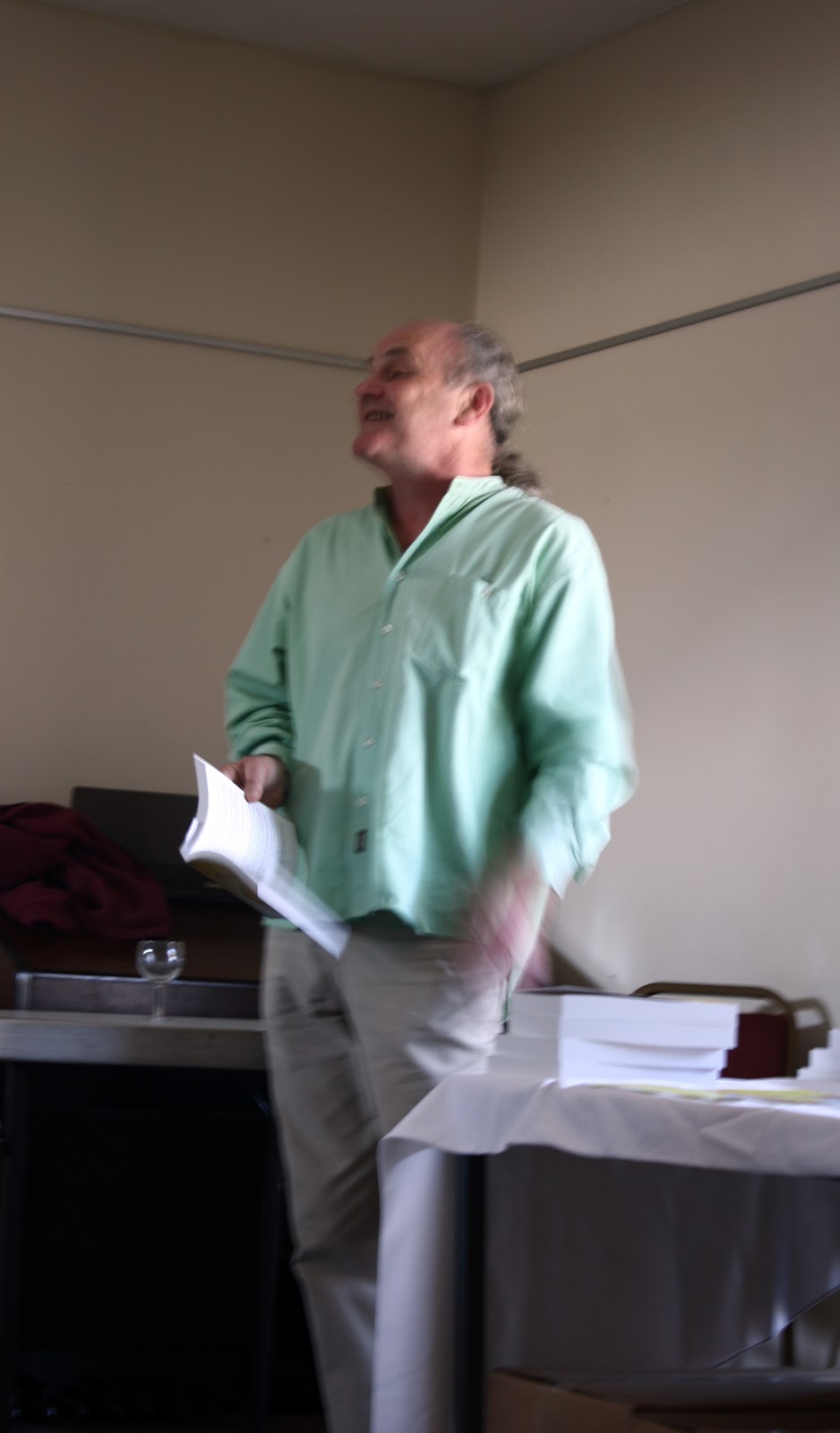
I'm going easy on myself this post as I'd really like to do some work on my next project before another week winds to a close.  I don't know if any of the 'hits' on this blog mean that anyone is reading it with any regularity, but if anyone is and wonders what I look like when I am animatedly reading a story from Wilful Misunderstandings, here's one taken by Jamie Delano at the launch...


Whoo hoo.  There was an audience.  I didn't dream it.  

Or did I?

Happy trails.

Monday, March 28, 2016

Coming Soon to a 'Buy Now' Button Near You - The Pitch!

Well, it’s four days ‘til Wilful Misunderstandings hits publication date and becomes available to anyone who chooses to purchase it.  I suppose if I’m going to do any serious hard sell in this blog, I really ought to get on with it.  That’s what I set it up for, for goodness’ sake.

Regular readers (if there are any of you out there) might have noticed by now that I’m a bit reluctant to take my ‘sales campaign’ all that seriously.  I kind of enjoyed talking about the genesis of the book and its (ahem) consciousness changing properties in the first 6 entries, but since then I have in what I hope is an entertaining way been avoiding heavy promo.

‘Wilful Misunderstandings’ falls somewhere between being a book that has been accepted by a commercial publisher and one that I have self-published.  Jamie Delano, who runs it, describes Lepus Books as a ‘publishing co-operative’.  What that means for me as a writer is that I’ve had to shell out for the print copies I’ll be selling personally and through the Lepus website, while a distribution/print on demand company takes care of e-books, sales through Amazon and any orders that come through bookshops.  Lepus is not set up to promote its publications, it just exists to get them into print and sell them.  Check out the website if you want to know more about that.  Jamie has to concentrate on selling his own books, as do Deborah Delano and Alistair Fruish.

That’s why the selling of ‘Wilful Misunderstandings’ is mainly up to me.  Late last year I started researching how I might go about it.  There is a lot of advice out there, especially on the internet.  After a while, I came to the conclusion that most of it wasn’t worth shit.

The once well-ordered world of publishing has been upended by the media revolutions of our times.  Self-publishing is accessible to anyone, regardless of quality.  Wherever there are opportunities to exploit, there will be those who jump in and exploit them.  And hey, there’s money to be made out of all these self-publishers who aren’t too sure how to sell their product.  You set up a website and present yourself as a successful writer who just wants to offer help to other writers.  You offer a few tit-bits of standard advice, which can just be lifted from any other websites that are doing the same.  You then promise much more info that can be obtained by subscription to your site, or purchase of your series of ‘how to’ books.  Or you offer reviews for a price.  Etc.

Disregarding most of that crap, on the whole, I’ve done what I can.  I’ve sent out copies of the book to newspapers and magazines, without any serious hope of getting a review – but if you don’t try, you don’t know.  There was just the possibility that maybe the somewhat peculiar nature of what I’ve written might strike a chord with someone.  I’ve set up a launch event (Shaftesbury Arts Centre, April 2nd, 2.00-4.30 – be there or be square) and got some local publicity.  That’s about my biggest hope for shifting a few copies.  I’ve put some stuff on Facebook, but don’t want to lay it on too thick.  I’ve buffed up my website and I reckon its worth a look if you haven’t been there - http://richeff.moonfruit.com/. . Twitter holds no appeal for me, so I continue to avoid it.

I’ve created this blog and I am committed to continuing it – but have no idea whether it will result in any sales.  Starting it was the result of a bit of advice I picked up early on.  The only positive effect I can say it’s had so far has been on Google page ratings.  If you Google my name only the ratings are swamped by Richard Foreman, the New York ‘Ontological-Hysteric’ playwright.  I don’t crop up til you’ve clicked through to page 14, by which time you’ll have spotted the 2 other writers who share my name and a fair number of obits for dead Richard Foremans.  But if you Google ‘wilful misunderstandings’, with or without my name, you sure get a lot of me.

So there we are.  Some campaign, huh?

Here’s what I hope.  I reckon I’ve written a pretty decent book of short stories, and there’s enough quality there to make it a more enjoyable and more interesting read than a good many self-published books, probably even some commercially published ones.  I hope that a few people will pick it up – starting with folk who know me and maybe going a little further (the words that Alan Moore and Sally Spedding kindly wrote to endorse the book might help somewhat).  I hope that some of them will enjoy it enough to recommend it and that word-of-mouth will result in more sales.  I hope that maybe some people will give me a good review on Amazon or Goodreads and the like, and that would help too.  I’m aiming to see if I can get myself some public readings of the stories and sell on the back of those.  Beyond that, who knows?

I don’t expect to make back what I’ve invested, but it would be desireable to reduce the number of book boxes currently stacked under a big table in my living room.  Above all it would be nice to think that a few people have enjoyed my stories.  It may not be the most riveting book you’ll read this year, but you’ll find some interesting characters, a few good laughs, some interesting situations, some thought provoking stuff and some strong emotional resonance.  That’s my pitch.  Be one of the discerning few.  Buy now from http://lepusbooks.co.uk/wilful-misunderstandings/

I’d like to think you won’t regret it.

Friday, March 18, 2016

Misperceptions, mistranslations and misinterpretations

Phew!  All this hard sell, I think I need a break from it, this time round.  So here's the result of a bit of fun I had last week.  There's a sort of a connection with Wilful Misunderstandings.  I went to a workshop run by Dorset poet David Caddy and it was about the idea of what you can get as a writer from re-interpreting things, including deliberate misinterpretations.  I'm not going to purloin all David's ideas and re-present them for you here (hey, check him out, he's on the web), but suffice to say that he was presenting the imaginative possibilities of mis-perceptions and mis-translations, translation as re-invention, that sort of thing.

As is the way of these events, those of us attending all had a go at seeing what we could do creatively with this idea.  Some great stuff came out of it and I thoroughly enjoyed listening to everyone's contributions.  As for me, I was looking round for something to 'mistranslate'.  We meet in a very nice pub in a Dorset village, and on the wall across from me was a blackboard with the 'Today's Specials' menu - which I could only partially see.  Unbeknown to either of us, the participant sitting next to me was also using this menu as a start point. She came up with something that could definitely be said to be poetry.  I'm not sure I did - I got a bit carried away with the humorous possibilities, I think.  So, here you go, tidied up and revised for a bit more consistency, this is what I did.

Today’s Specialists:

1. Addled Imperialist
With chips off old blocks, peas in our time and badgered broccoli.

2. Hard Boiled Agent
Set in a succulent garnish of polonium, with treachery tarts and diced disinformation.

3. Sweet and Sour Celebrities
Banter basted in a slick trivia sauce and topped with spicy innuendos.

4. Mackled Minister
Stuffed with a fat wad of dough and civilly served with shredded documents.

5. Braised Pundit
Tossed off in tasteful tautologies and lightly layered in a filigree of fine leaves.

6. Curried Migrants
With single grain rice.


Our Chef Commends:

1. Royal Mint Pie
Quantitatively eased onto a bed of raised salaries, gilt investments and dire warnings.

2. Cod Almighty
Richy coated with an intolerant sauce, vengefully spiced and served by billions.


And don’t go without trying our

Post Nuclear Desserts:

1. Baked Alaska
2. Molten Lava Cake
3. Death By Chocolate
4. Spotted Dick
5. Glazed Madeleines
6. Crumble


But I'm really gonna be pushing my book down your throats next time, for sure.  Well, maybe.

Toodle pip.


Friday, March 11, 2016

23 Darned Good Reasons to Buy ‘Wilful Misunderstandings’

That April 1st publication date is coming up fast.  It's time for me to go (in my quiet and thoughtful way, of course) into 'hard sell' mode.  So here goes...

23 Darned Good Reasons to Buy ‘Wilful Misunderstandings’

1 It has an attractive and colourful front cover that will look good on your coffee table.
2 You cannot resist purchasing the work of anyone who has been described as ‘quirky’.
3 No story in the book is more than 2000 words long, so if you’re not enjoying the one you’re reading, you won’t have a long wait ‘til the next.
4 Ownership of this book will distinguish you as an authentic individual.
5 Ownership of this book will demonstrate irrevocably that you are not a prey to the pernicious marketing techniques that currently dominate the publishing industry and do not restrict your tastes to ‘best sellers’.
6 At 34 stories for £8.95 you are getting incredibly good value for money – how can you go wrong at a mere 26.323529411 pence per story?
7 You ARE too hip for genre, just like it says on the back cover blurb, and you have realised this book was written precisely for the likes of you.
8 Although there is a vanishingly remote chance that this book will be the surprise left field publishing hit of 2016, imagine if it was…  and you had bought it at the time of publication, long before all the hoopla began.  Kudos or what?
9 You are one of the small number of people who saw some of the comics stories I wrote back in the 1990s and you’re curious to know what I’m up to now.
10 You need to satisfy your curiosity as to what value Alan Moore, Sally Spedding, Jamie Delano and a few other people you might have heard of have all seen in this book.
11 You have £8.95 burning a hole in your pocket and you just can’t think what to do with it
12 You need a gift for someone else to whom all or some of these reasons apply.
13 Purchased in bulk, copies of this book would make excellent (if somewhat expensive) loft insulation.
14 There is a gap of approximately 23 millimetres spine width in your book shelf that needs filling.
15 You have read all my previous blogs and decided that you too need to develop the mental flexibility that my book could conceivably confer and that might just help us get through the next few decades without wrecking every ecosystem on the planet.
16 You are a fan of adult colouring books and would get pleasure from colouring in the various line work designs that appear on blank pages between stories in this book (as previewed in this blog).
17 You love the smell of freshly printed books and just can’t get enough of sniffing them.
18 You are one of my few surviving relatives.
19 I owe you money and you think if enough people buy this book, you just might get it back
20 You are looking for 34 enjoyable stories, most of which have beginnings, middles and ends, that will not – on the whole – tax your brain too heavily, but will nevertheless leave you with the feeling that you have read something worth your time, money and effort.
21 You just like the idea of reading a book that isn’t quite like any other book you’ve ever read.
22 Turn it upside down and the back cover will also look nice on your coffee table.
23 You feel sorry for any bugger who wastes his time thinking of 23 reasons why you should buy his book and you reckon he needs to earn enough money to buy himself the counselling and psychiatric support he obviously requires.